by student staff*
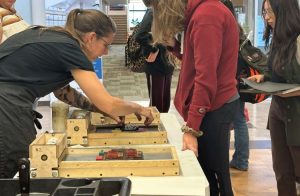 Students got their hands dirty at PPSC’s first Type High Day event in September. Organized by Besty Tuma of Multimedia Graphic Design, the workshop featured a history lesson on the Union Printers Home and a hands-on, letterpress experience.
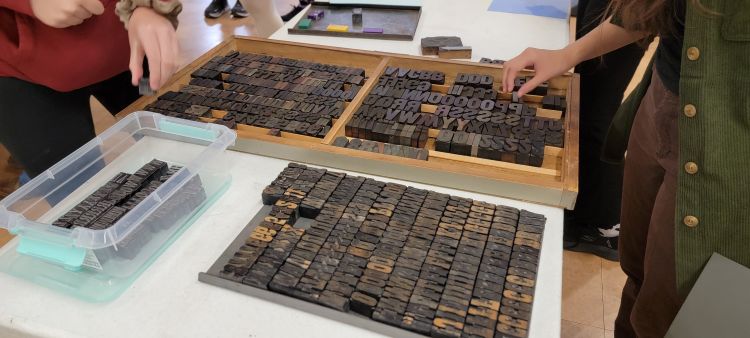
The date 9/18 and name of the holiday commemorate the term “type high,” which refers to the standard height of printing type* used in the traditional process: 0.9186 inches. 
Tuma says her motivation for the event came from her passion in the craft. “I love history,” she says, “and the historical aspect of being able to print feels like tangible learning.”
“I hope students fall in love with typography. I want them to get an appreciation for how easy it is to choose type and develop a tangible love for typography,” says Tuma.
Before attendees participated in the art of typography, Director of History and Archives Ellie Hinkle presented on the history of the International Typographers Union (ITU) and the Union Printers Home**, 101 S Union Blvd.
The event attracted a variety of students and faculty. Boone, a current student in the multimedia and graphic design program, used the press and said, “I like it, I think it’s a good way to get out from behind the screen.” 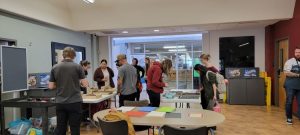
The following day, Colorado College hosted The Letterpress Printing Workshop for the PPSC community. In this workshop, attendees worked in groups to design and print posters using the Colorado College’s Vandercook Letterpress Machines. 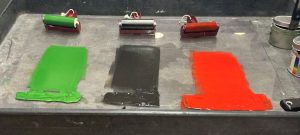
*This style of typing was originally installed to ensure that all printing elements are the same height on paper, keeping the printing impression consistent. Writers in the 1800s wanted their papers to be legible, and typing highly created that consistent layout and appearance of the text. Typing high originally only pertained to uses of printing press, moreover, it now applies to any surface. The specific height that the lettering or symbols are printed at is determined by each individual country. For example, Europe has a different height standard than the U.S. and the U.K.
**Built in 1892, the Union Printers Home was a place of rest and retirement for members of the ITU. At its peak, the ITU was the largest labor union in the world, and very powerful. It was instrumental in creating equal workplace rights for women, the 8-hour workday, and the 40-hour work week, which are now codified in the US.
An interview with Printmaker Jess Snow:
What about the printing press intrigues you?
I enjoy the way different technological advances built on one another over centuries to do two fairly simple but important tasks: 1) transfer ink from an object (in this case, a group of letters and images) to a substrate (in this case paper) and 2) create multiple prints from one form (the grouping of letters and/or images). The ability to create multiples relatively easily and quickly was game changer and it’s one of the main reasons the ability to read for oneself came to the masses! To be able to read and critically think for yourself allows for the incredible ability for ideas to be exchanged, debated, agreed upon, and to connect collectively. It may be hard to imagine how centuries old technology relates to our modern digital life, but the development of the printing press, paper, and moveable type are foundational to the way civilization and communication are embodied and distributed today.
Why do you do it?
For so many reasons actually. For one thing, it’s an incredible antidote for the numbness I can feel as a graphic artist when designing, illustrating, and creating in a fully digital environment. I end up getting tunnel vision when I’m staring straight ahead into my computer for hours that I just don’t get when I’m moving around my shop and working with actual pieces of type or illustrations. It’s a very iterative and creative process. I often have these incredible happy accident moments that I would never have working in a solely digital space. I have always worked back and forth between analog and digital spaces with my illustrations, but when I started working with physical pieces of type and spacing, I feel like my digital typography expanded and improved.
But also, it’s incredibly powerful to have the tools of production in-house. No one is going to censor me by not printing my work when you own the press and the type. There’s incredible catharsis when you pull a print off the press after painstakingly arranging the type that brings voice to your thoughts or what’s on your heart and mind. I try to share that with others so that I’m not the only one having this incredible experience. The press throughout the ages has been an incredible tool for voicing dissent and also imagining future possibilities, and I like to make it beautiful as well.
What do you hope people gain from the event?
I hope for a lot of things! I hope for curiosity! I hope that participants caught a glimpse of and connected with the endless possibilities that exist when working with these materials; whether it’s literal words or abstract combinations of shapes made from letters. Plus, it’s a full sensory experience, one that I hope elicited joy. I hope that folks saw why this seemingly dusty old technology is actually a vibrant and useful way to connect with one in another. It truly can build community. For one, it’s a lot of work that’s made light by many hands, but also I’ve had some of the best conversations in my life with fellow printers while working on press together. I know it’s lofty to think that printing can do so much, but analog letterpress printing and printmaking, unlike many other art practices, really is best as a communal, shared practice. To me, I hope that people see that connection or at least the possibility of that kind of connection. I could talk so much more about any of these questions. Each question truly contains multitudes. Thank you for asking me to share why this medium means so much to me.
An interview with Ellie Hinkle, Director of History and Archives at Union Printers Home:
What is it about history that intrigues you?
Ellie says coming from an archives background, “[her] passion for understanding what things were like for people,” is what lead to her intrigue. She asks the question, ”How did this impact your average person from day to day?” Ellie used to work in college housing, and she finds it interesting to see how the roommate complaints from grown men are the same as what you would see coming from college freshman. She says that her interest was also sparked by seeing that, “people are always people,” no matter what.
What do you hope people gain from this?
Ellie portrays the story as being a Unique Colorado Springs story that many people don’t know. She says she hopes that this event plays a part in, ”Helping people connect with the fact that things weren’t always so simple.” She poses the question: “Did you know a printer used to be a person?” She ends with the mention that she hopes people can see the beauty of the slow and the intentional.
*Kieren Heinle, Delta Taylor, Ephraim Churchill, Thomas Pickern, Sofia Mattix, Justin Jun, and Nicole Spano


